

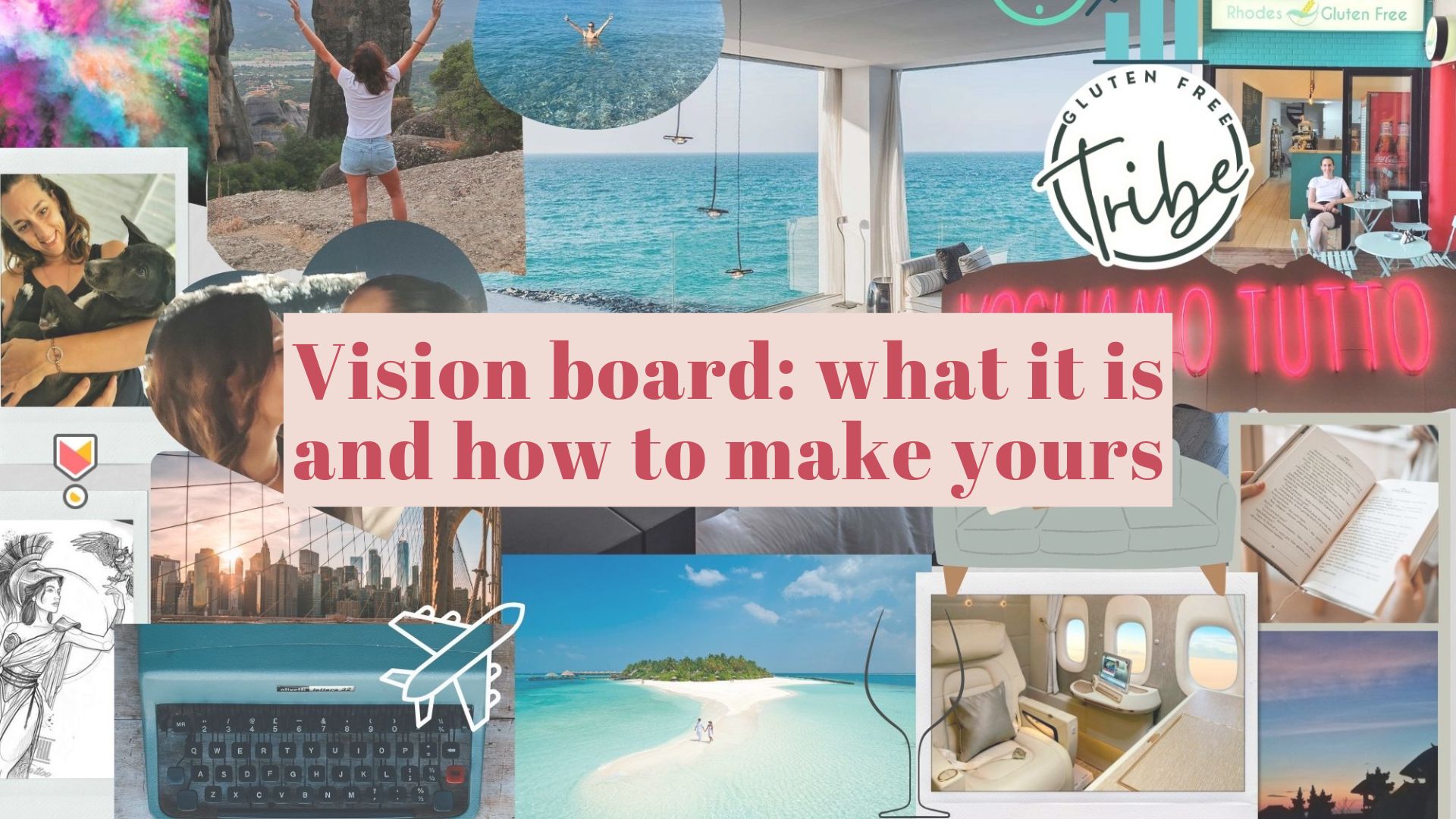
Vision Board: what it is, how to make yours, and why it’s so powerful
Maybe you’ve heard about vision boards before, and perhaps you thought it was a hippie idea for gullible people – or just a pretty collage of images and quotes. But a vision board is much more than that.
For many people – especially expats, travelers and digital nomads – it can become a practical tool to stay focused, motivated and connected to their goals, even while life keeps changing. Or at least: for me it’s exactly that, and I haven’t skipped a year since when I first found out about this interesting tool.
In this article, we’ll explore what a vision board really is, how to make one step by step, and why digital vision boards are often the best option for people who live a flexible, location-independent lifestyle.
What is a vision board?
Let’s start from the beginning, for those who have no idea of what we are talking about.
A vision board is basically a visual representation of your goals, intentions and desires.
It’s usually made of images, words, quotes and symbols that reflect the life you want to create – personally, professionally, emotionally or all of the above.
The idea behind a vision board is simple: when you see your goals every day, you keep them present in your mind. And what you focus on consistently tends to influence your decisions, actions and mindset.
This concept is closely linked to the law of attraction, which is based on the idea that your thoughts and beliefs shape your reality. While it’s not magic, it is a powerful way to clarify your intentions and stay aligned with them.
A vision board doesn’t replace action: it supports it.
Vision boards and the law of attraction
As we said, vision boards are often associated with the law of attraction (the idea that focusing on something helps bring it into your life).
In practice, what really happens is:
- you become more aware of opportunities
- you make decisions aligned with your goals
- you subconsciously change your habits
It’s not about wishing. It’s not about passively waiting for things to happen.
It’s about direction + intention + action.
Let me give you a personal example of how powerful this law can be.
When I was at University, for years I had one specific photo as the desktop of my laptop. It was the picture of a Buddha statue seen from the back, surrounded by stupas, all made of dark stone, with a night moonlight sky. I had found it online, I chose it only because I liked it and it gave me a sense of peace and focus. It made me feel centered, and simply good.
Years later – like 10 years later – I went on my first solo trip to Indonesia and, among other things, I visited the Borobudur temple on Java island. I took a lot of pictures of that place, not just because it was beautiful but because it had an incredible energy. At the end of the trip, when I was going through all the photos I took, I felt like one of them (the one you see below) looked particularly familiar… and at first I didn’t understand why. Then, all of a sudden, I understood: it was exactly like that photo that I had on the desktop of my computer for years, a decade before. Only the sky was different, because I went to the temple in the afternoon – not at night.

But yes, my desktop picture was taken in Borobudur – a temple that, back then, I didn’t even know existed. But a temple whose energy kept calling me for all that time, until I finally ended up there. Not because of some kind of sorcery, but probably because my needs, my emotions, my life path brought me to a place where I could live in first person what I had only seen through a screen until then.
Pretty fascinating, right?
Why vision boards are especially powerful for expats and travelers
In general, we – expats and digital nomads – know that when you live abroad or move frequently, life tends to feel less structured. You change countries, routines, houses, sometimes even identities. If you’re also a multipotentialite like me, good luck! 😉
I believe that we need some kind of structure, somehow. And that’s exactly why vision boards work so well for us.
They help you:
- stay connected to your short and long-term goals
- create a sense of direction even in transition
- visualize stability while living a flexible life
- avoid feeling “lost” between moves and life changing events
For many people living abroad, a vision board becomes a grounding tool, something that stays constant even when everything else changes.
How to make your vision board (step by step)
It’s not hard to make a vision board, but if you’ve never done it before you might need some guidance at the beginning. I learned all about this powerful tool during a workshop in Bali, at the beginning of my digital nomad life.
It was the end of the year, 2019 I believe, and the coworking space that I was going to organized this event. I am one of those people who don’t miss a chance to learn something new, so I seized the opportunity and went with my notebook and my laptop.
As you can tell by the fact that I’m here writing this article, I loved the concept of the vision board: it resonated perfectly with me and immediately became part of my Christmas/end-of-the-year rituals. As I said before, I haven’t skipped a year since. I always use the previous vision board to check which goals I reached and which ones still need work (or which don’t seem relevant anymore), and then use it as a base to create the new one for the following year.
But what if you’re starting from zero? Here are 5 easy steps to make your own vision board from scratch.
1. Get clear on your intentions
However tempted you might be to start by choosing images, the first step is all about intentions. If you don’t have clarity, the vision board will never work.
Before scrolling images to choose, ask yourself:
- What do I want more of this year?
- How do I want to feel?
- What areas of my life need attention? (work, home, health, travel, relationships…)
- What are my short-term goals for the year? (e.g. learning a new skill, adopting a dog, eating at a Michelin star restaurant…)
- What are my long-term milestones? (e.g. owning a seaview villa, being and influential professional in your niche…)
Do you want to focus on your career next year? Admit it to yourself, and don’t fill your vision board with wishes for a new romantic relationship if that’s not what you want.
Do you want to triple the savings in your bank account? Be specific and add that to the vision board too.
Do you want more travelling and chilling, and less hustling and stress? Nothing wrong with that!
Perfect answers don’t exist, that’s not what you need: you just need honest ones, that are really aligned to who you are right now and who you want to be.
2. Choose the format
Vision boards don’t come in one single format – you can choose the one that suits you best.
Also, they are visual because they contain pictures (which are powerful because they speak better to our subconscious) but they can also feature keywords or quotes.
But where do we put all this?
Physical vision board
You can make it on a big piece of paper or cardboard, with pictures cut from magazines, photos, scissors and glue. Or, if you prefer, you can use a pinboard to hang to your wall for a more flexible and customizable option (reusable too, year after year). In that case, I would suggest you a pinboard like this*, which is also aesthetic and available in different colors to match your home interiors. (*This is an affiliate link, which means that I might earn a commission from your purchase.)
This is definitely a creative and very tactile option, perfect if you love arts-and-crafts, but not very practical if you move often.
Digital vision board (recommended for expats)
My personal favorite, because it’s super versatile, you can always have it with you and you don’t need much to create it.
You can use the photos on your phone, download pictures from websites, and then assemble everything with tools such as Canva (see point 4).
This is also a kind of vision board that can be easily updated in case you want to refine it or check the situation halfway through.
3. Collect images that truly resonate
When you have clarity about what you want to put on the vision board (see point 1), you need to find one or more visuals that represent all of that.
They can be:
- places
- homes or home interiors
- words or affirmations
- work environments
- lifestyle moments
- abstract pictures that represent feelings
- actual photos of you that mean something specific
Tip: don’t overthink it. If an image attracts you, there’s probably a reason. If one “talks” to you more than another, that’s the one you should choose – even if it’s less aesthetic.
Where to find all these pictures? Well, besides your phone… you can use AI to generate them the way you want, or download them from websites such as Unsplash (my personal favorite).
4. Assemble your vision board
If you’re opting for a physical vision board, arrange your clippings intuitively, without aiming for symmetry or visual perfection, and let it evolve. You will adjust it little by little until it feels right. Then stick everything with glue and you’re good to go.
If you prefer the digital vision board, my suggestions are:
- keep it clean
- avoid clutter
- leave space to breathe
- focus on emotions, not perfect aesthetics
I always create my vision board with Canva, free-hand (or better: using the one from the previous year as a base to develop the new one). If you need inspiration to start, or you want it to be a bit prettier too, then you can start from one of the many templates available. Choose one that resonates with you, then personalize it with your pictures and you’re done! Don’t do it all at once: spread the work along different days so that you have more clarity about the final result.
5. Keep it visible
Ok, the vision board is ready. Now what?
This last part is essential: you have to keep it visible. The power of this tool comes from repetition and visual reminder. If you just make it and then forget about it, nothing will happen. But if you have your goals in front of your eyes every single day, you will be way more focused and you will act accordingly – even when you don’t realize it.
So go on and use your vision board as phone wallpaper and laptop background. You can also print it and hang it in your house, or pin it in the planner that you use daily for work.
And I will tell you more: don’t just show it to yourself – show it to others too. Share it with your partner, your friends, your family. Tell them what it means for you, let them know what you’re aiming for. And, if they want, they can do the same for you. Ask them to keep you accountable if things get rough and you lose your focus. This will make it even more powerful!
Vision board examples
Let me show you a couple of examples of my own vision boards.
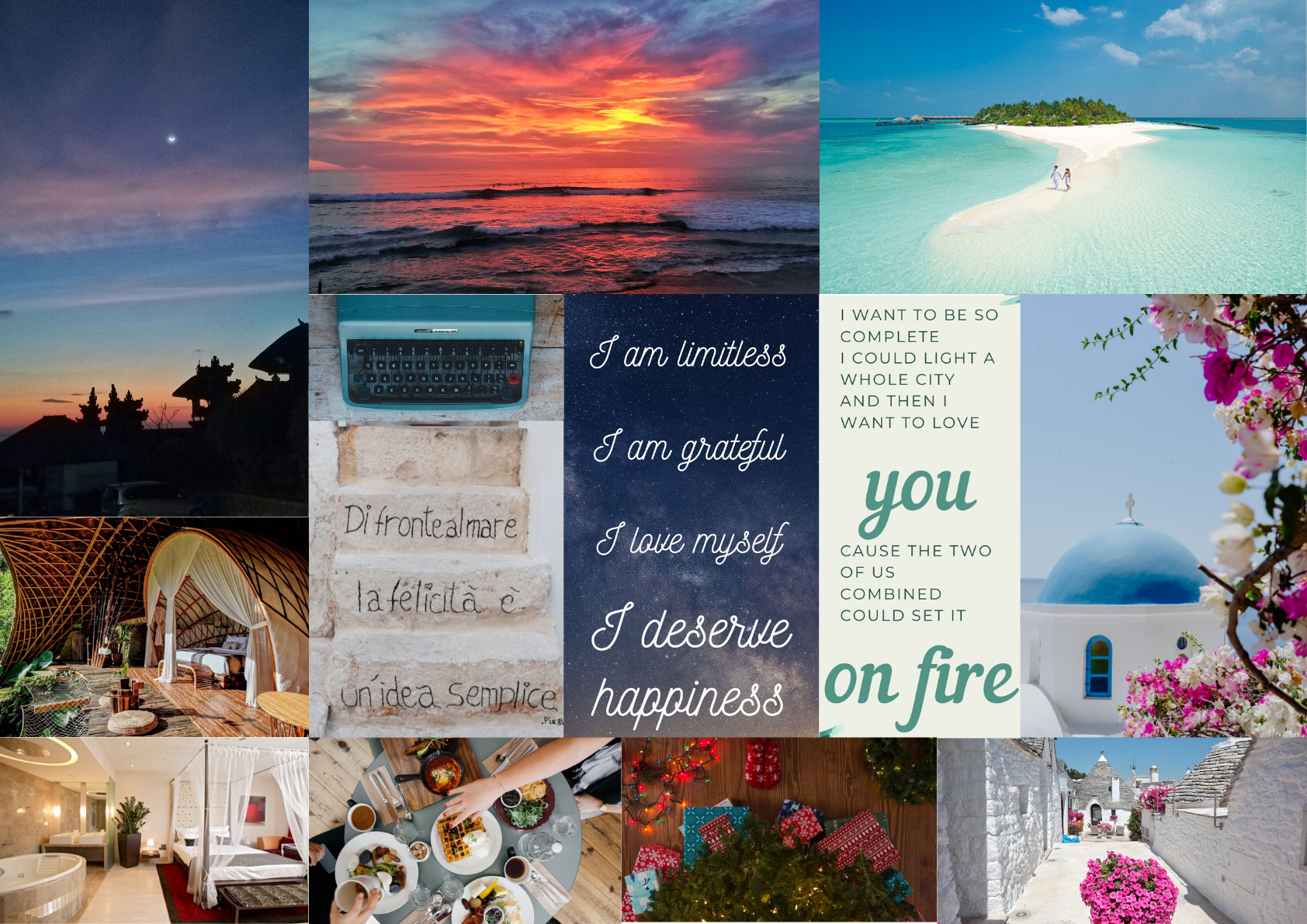
This is the very first one I made, with a big focus on words and affirmations, one big picture (on the top right) that represented the romantic relationship I was looking for, some photos of places where I wanted to go (or go back – including Christmas at home), and a bit of space for work and lifestyle goals. Very simple, but it represented perfectly who I was back then.
This is the one from last year, that will soon be replaced by a new one. Way more full, because – as I say – “Vogliamo tutto” (which means “We want everything”). Unfortunately my multipotentiality doesn’t allow me to be much minimalistic when it comes to vision boards! 🙂
But I stil prefer to have all of my goals in one board – although you can easily create different ones for different areas of your life (relationships, career, health, travel goals, house…).
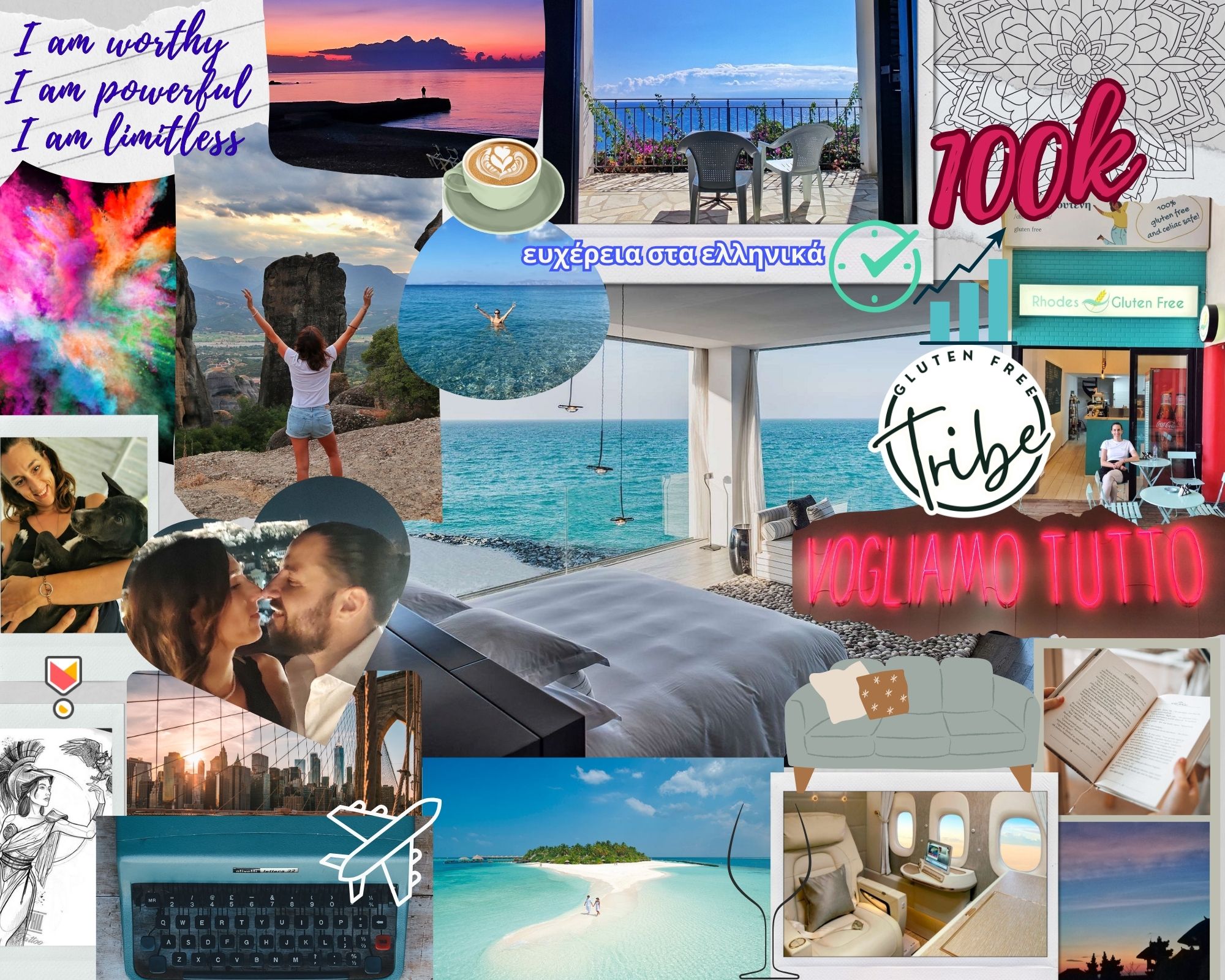
Some things are clear only to me – and that’s absolutely normal! – so I’m not going to explain everything here, but I just wanted to point out that vision boards don’t have to be about “big dreams” (or not only, at least). The book on the right, for example, only means that one of my goals was to read more. The green clock, that I wanted to take some free time for myself. The picture of Athena on the bottom left, that I wanted to get a tattoo dedicated to that goddess.
This is your space, these are your wishes and goals. No one will judge you – you should not judge yourself either.
Do vision boards actually work?
Let’s be clear: a vision board won’t change your life overnight. Or even in months. Not if you don’t take action!
But it can definitely help you stay aligned, focused and intentional, especially when your life doesn’t follow a straight line.
So yes, I think that – especially for expats, travelers and people who live between places – vision boards are a powerful tool because that clarity can make all the difference in achieving your goals.
And the best part? You can update your vision board anytime – just like your life.
Have you ever created a vision board? Did it work for you? I wait for your experiences in the comments section!
F.A.Q.s about Vision Boards
A vision board is a visual tool made of images, words and symbols that represent your goals, intentions and desired lifestyle. It helps you stay focused and aligned with what you want to create in your future life.
A vision board works by keeping your goals visible every day, reinforcing intention, clarity and motivation. It combines visualization, mindset, law of attraction and consistent focus.
To make a vision board: clarify your goals, choose images that represent how you want to feel, and assemble them digitally or physically. Digital vision boards are especially practical for expats and travelers – and my personal favorites.
There isn’t a universal answer, but for people who move often or live abroad, digital vision boards are usually more practical. They’re easy to update, portable and can be used as phone or desktop wallpapers.
Vision boards don’t work by magic alone. They help by increasing awareness, focus and intentional decision-making. They need to be paired with action in order to bring you somewhere, of course.
Ideally, every day and also multiple times per day. Keeping your vision board visible helps reinforce your goals and keeps them present in your daily mindset.
Yes. Vision boards are very useful during life transitions, such as moving abroad, changing careers or starting a new chapter. They help you have a clearer mind – and act accordingly.
You can include images, words and symbols that represent your goals, values, emotions and desired lifestyle – not just material achievements.
Many people (including me) create vision boards at the beginning of the year, but the best time is whenever you feel a shift or want more clarity and direction.


No comments yet