

Learning modern Greek: loving a language isn’t the same as speaking it
This is my love story with Greek – and my experience learning modern Greek. Find a comfortable spot and take your time: it’s long, but worth it. Read on, and avoid the mistakes that I’ve made…
I’ve always loved languages. Not in a casual “I’d love to be fluent one day” way, but in a slightly nerdy, very personal way. I mean: I ended up working with words because I adore them, after all!
Sounds, pronunciation, etymology: they fascinate me. I pick up accents quickly, sometimes too quickly – especially the regional Italian ones. And I end up mirroring other people’s pronunciation without meaning to, to the point that occasionally they think I’m mocking them. I’m not, I swear! I can’t help it, I just absorb sound.
Italian is my mother tongue. English feels like a second skin at this point. I studied French for years and still understand it, even if I don’t really speak it anymore. I learned Indonesian too, when I was spending long stretches in Bali. And long before any of that, there were Latin… and Ancient Greek.
Five years of it in high school. It was my favorite subject by far: I loved the logic of it, the mental gymnastics of translation, the literature. In fact, I loved it so much that, during my first year of university, I kept translating texts on my own just so I wouldn’t lose it (even though I had chosen a completely different path). Somewhere in my teenage mind I used to think that I must have been an ancient Greek in a past life. (Who knows, maybe I was right!)
So when I eventually moved to Greece, it didn’t feel random. It felt like a thread that had been there all along.
And yet, loving a language and speaking it confidently are not the same thing.
When Greek became real in the present
The first time I realized Greek could be more than a school subject was right after my high school graduation, during a trip to Crete.
I remember asking a bus driver a question, instinctively using Ancient Greek. Now I know that it was very similar to its modern version – that’s why he understood what I was asking, and he replied (in modern Greek of course). And I understood him back! It felt like a bridge across time, almost a romantic moment.
Anyway: for a long time after that, Greek wasn’t urgent in my life.
When I lived in Crete during COVID, I was surrounded by it because I stayed in a small village where few people could have a real conversation in English. My Italian roommate was studying it because she was planning on staying. But I wasn’t, so – to be honest – I didn’t even try.
The shift happened when I came to Rhodes for the first time, and I felt like it could be a place where to settle for a while.
Whenever I stay somewhere long-term, I try to learn at least some of the language. I did it in Indonesia, and it felt natural to do it here too. At first, the motivation was partly practical and partly a nice cultural gesture. Plus, as I said, I just love learning languages.
Then I met Nikos. Then we started a business. Then I chose to build my life here.
At that point, learning Greek was no longer optional: it became romantic, professional, absolutely necessary and deeply personal all at once.
My (too) long relationship with Duolingo
My first real commitment to learning modern Greek was through Duolingo. I used it consistently for almost three years, I was bullied by the green owl and I ended up completing the entire Greek course. Every unit. Every level.
Did it make me fluent? Not even close.
But it did something: it built familiarity, trained my ear, expanded my vocabulary (some areas were more useful than others – yes, there is something beyond “To karoto einai roz”). It exposed me to linguistic patterns and helped me recognize grammatical structures. Basically, it gave me minimal daily contact with the language.
What it didn’t give me was the grammar rules, and most of all the ability to speak without hesitation. It didn’t give me the confidence to enter a shop and interact with the seller in Greek.
Let’s say that Duolingo made modern Greek less foreign, but it didn’t make it mine.
It’s something that you can do on the side, while you wait in line at the post office, but it won’t change your speaking life.
The second step: private classes
When I realized I would be staying in Rhodes for a while, I also decided to take modern Greek 1-to-1 classes with a private teacher. We did them online, once a week, and I had homework and everything. It was a mix between vocabulary and grammar, but again: it didn’t teach me that much.
This time, the reason was that I didn’t really click with the teacher. Maybe her teaching style was not right for me, or maybe I didn’t match with her as a person. The fact remains that the classes lasted for a few months and then slowly died.
After that, I paused for a while – or better: I tried to learn modern Greek on my own. I bought grammar and exercise books, and every day I was working on them a bit (while still keeping up with Duolingo).
It was going pretty well I would say, until I had the brilliant idea of opening a café which ate all of my free time – so my books were forgotten on a shelf, collecting dust. On the positive side, having a shop exposed me to the Greek language like never before, and boosted my comprehension levels.
The confidence problem
To be honest, understanding Greek has never been my biggest struggle. Right now, I understand almost everything I hear, unless it’s highly specific vocabulary. I can follow conversations, and I am very intuitive so I can deduce the overall meaning with just a few “hints”. Basically, I can easily sit at a table where everyone is speaking Greek and know what’s going on. And then, when it’s my turn to speak, I will very likely do it in English.
Why, if I know the necessary vocabulary to understand what I’m hearing?
In my case, the biggest obstacle to confidence is grammar, which is more complex than Italian grammar for sure. Cases, endings, verb forms: you can’t improvise your way through them. To speak comfortably, you (well, I at least!) need control. And control requires practice that goes beyond passive understanding.
The irony? My pronunciation is excellent. When I speak Greek, people who don’t know me don’t immediately realize I’m Italian. They compliment me on my accent, which makes it even more frustrating that grammar is what slows me down.
I can sound fluent, but I’m not.
And then there’s the phone. I always feel a small wave of anxiety when I have to answer the shop phone in Greek, worried I won’t fully understand what the customer is asking. In face-to-face interactions, especially in food-related contexts, I can manage. That vocabulary came quickly and has taken root thanks to every hour spent behind the counter of Rhodes Gluten Free. But real-time conversations without visual cues? That’s another level.
There’s a big gap between comprehension and production. After almost four years here, I am pretty sure of that!
What moved the needle – or at least I hope
The biggest shift in my learning journey came from conversation. Not with my boyfriend – too easy, right? But no, we mostly speak English at home so I don’t really practice.
Recently, I completed two months of weekly conversation sessions specifically to work on fluency and confidence.
That made a difference. Not a huge one – I’m still insecure – but I went to shops and offices after finishing, and I spoke almost only Greek. Funnily, it comes easier to me when I’m speaking to someone I don’t know. With friends, I feel less confident. Our brain is weird sometimes…
Anyway, for sure speaking regularly with someone who doesn’t let you switch languages forces you to think differently. My teacher, Vasianna – who is also a friend, and a language nerd like me – creates an environment where mistakes aren’t embarrassing. They’re actually necessary to improve. And, meeting after meeting, assignment after assignment (where you MUST speak), you feel a bit looser.
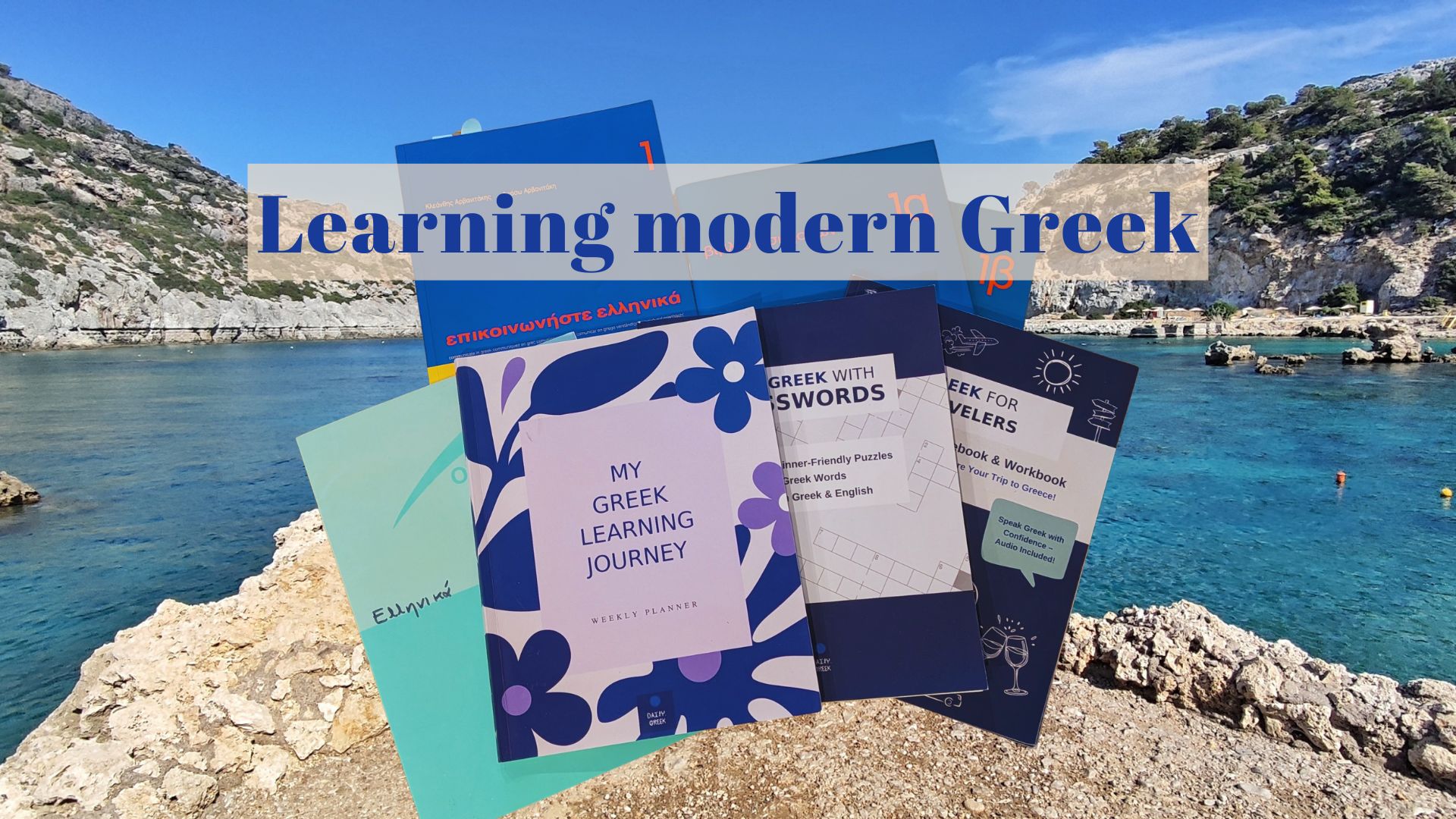
Besides her conversation group, she also runs an amazing Instagram account, daily.greek, and she published creative learning books (crosswords, simplified stories, vocabulary and phrases exercises) that I warmly suggest you. All these tools are great to integrate Greek into your daily life, in an entertaining way (forget about boring academic teaching).
Given all this, if I could start my journey through Greek again, I would do it differently. How? Well, keep reading to find out.
If you’re thinking about learning Greek, here’s what I’d suggest
If you’re considering learning modern Greek, skip my mistakes and make the best out of what I’ve learned the slightly long way.
1. Make Greek part of your daily life even before officially starting your learning journey. Follow daily.greek and other social media accounts you will find, listen to Greek songs, read menus or labels in Greek, expose yourself to the language as much as you can. Every micro exposure counts beacuse it adds up.
2. Don’t rely on apps alone. They’re useful (I wouldn’t undo my three years of Duolingo… or at least a couple of them) but they create familiarity, not fluency. Use them as a side gig to build vocabulary and consistency, not as your only method.
3. Invest in grammar earlier and more consistently than you think you need to. Greek grammar is not impossible, but it is complicated (even for those, like me, who are familiar with ancient Greek). Cases, endings, verb forms are the scaffolding that will support everything else. The stronger your base, the less mental gymnastics you’ll have to do when you try to speak.
4. Start speaking before you feel ready. I didn’t and I still struggle with it. I’ve been waiting to feel prepared enough, which basically means I waited too long and now it’s hard to start. Confidence doesn’t come after perfection, but from small and often uncomfortable repetitions.
5. Separate “understanding” from “speaking”. You can understand 90% and still freeze when forming a sentence – that doesn’t mean you’re bad at the language. It just means you need active practice.
6. Accept that learning Greek, especially as an adult, is not a straight line. It’s plateaus, small breakthroughs, long pauses and sudden leaps. In my opinion, the key is not speed but continuity.
You don’t need to become fluent in a year (spoiler: you most likely won’t!).
You just need to open your mouth and stay in the conversation.
Living in Rhodes: help or obstacle?
How could living on a Greek island ever be an obstacle to learning the language, you wonder? Well, if that island is full of foreigners (expats, not just tourists) and if the locals mostly speak English… it can.
The truth is that living in Rhodes helped me decide to learn Greek more seriously, and that’s a given. But it’s also true that here almost everyone speaks English, at least at a basic conversational level. Many people speak Italian too (yep). It’s so convenient, at the beginning! But we all know that convenience is comfortable, and that comfort doesn’t push you to grow.
Even in a place like Rhodes, where you can easily “survive” with no Greek at all, there are situations where English isn’t enough. Bureaucracy. Contracts. Business matters. For example, I would never have been able to open Rhodes Gluten Free without Nikos handling the Greek side of things. Language, in those contexts, equals autonomy.
What learning modern Greek means now
And autonomy is probably my strongest motivation now: I don’t want to feel like (and I can’t be) a permanent guest here. I don’t want to need someone else to navigate my own life in Greece.
It’s also a matter of respect for the country where I live.
It’s about integration because, again, I don’t want to be looked at as “the foreigner” forever.
More practically speaking, it’s about being able to answer the phone without anxiety, to handle paperwork, to explain myself in offices or shops.
But also to communicate with older relatives who don’t know any English.
Basically: to exist fully in the place I chose.
One thing is sure for me: I’m not fluent yet, I still hesitate and overthink. But also, I’m no longer just studying Greek. I’m inhabiting it.
And maybe that teenage version of me, translating ancient texts just for the joy of it, would be proud that the language she loved is no longer just an academic exercise: it became part of her everyday life.
Now I want to hear from you though: are you learning modern Greek right now? Have you done it in the past – and was it a success? Please share your story in the comments!
p.s.: I can’t even begin to tell you how much I would love my Greek teacher from high school to know that life took me here…
(Disclaimer: this article contains affiliate links, which means that I might earn a commission from your purchase.)

No comments yet